Magic is as integral to D&D as dragons and faeries. It allows for anything to be possible; from creatures with strange, otherworldly abilities, to travel between planes, to crazy spells such as being able to polymorph into a dinosaur! But, to paraphrase a well-known superhero movie, with great power comes a great deal of rules!
The 5th edition rules for D&D have tried to keep spellcasting (using magic to affect something) as simple as possible, but it still takes some getting used to. That’s what we’re here to do…
In this first article, I’ll look at the different types of spellcasters.
Your spellcasters come under the following types…
1) those who have a natural gift for magic 2) those who study it 3) Those who are blessed with magical powers for their beliefs 4) Those who pick it up as they go along
The natural
The sorcerer is the gifted magic user, who has through some cosmic reason or exotic lineage been chosen to carry such power.
The student
Wizards are keen to master magic and require spell books to record what they have learned and to prepare their daily spells. Eldritch Knights also study magical techniques to enhance their fighting prowess. Monks learn to channel magical energy known as ki.
The blessed Clerics and Paladins draw on the divine magic of their deity. Warlocks gain powers in return for serving their patron (an otherworldly being). Barbarian Totem Warriors also gain gifts through their spirit animal. With nature as their muse, Druids and Rangers learn to use magic from their environment.
The knack
Gifted performers known as Bards learn tricks on the road as they perform and can weave magic with their music. The Rogue type, Arcane Tricksters also learn tricks which enhance their shadowy lifestyle.
That’s enough magic talk for now. If you want to discuss anything in particular, let me know. Next time, we get into the rules…
In a week when the Best Picture at the Oscars featured a fishy lead in The Shape of Water, here is a way to introduce a fishy feel to your D&D campaign. Set these NPCs loose on the story, for free:
These characters are part of a Sub-Aquatic Six Pack I have created. All six characters have been given character class levels and a rich backstory to bring them to life. If you’re interested in taking a look at the full version, it is available on the Dungeon Master’s Guild, for under $5.
If you are interested and do get a copy, please let me know what you think.
There are many skills DMs can improve and hone over time, such as story-telling, improvisation, characterization, learning and adapting rules as well as diplomacy with a party of players who aren’t getting along. It can be exhausting building worlds and frustrating swapping out plots they made for new ones the players choose to follow. But it can also be very rewarding.
So what is the most important part of being a DM? A sense of humour is important, for sure. Patience is definitely a virtue. Imagination is very important and adaptability vital. But to outline what I consider the most important factor in being a good DM, watch DM Matthew Mercer in the following classic clips from Critical Role:
My personal answer to this question is simple; It’s listening. It’s giving the players the space they need for their characters to grow and be creative. The DM facilities their adventure, he does not control the players. This means that the characters have room to interact and have brilliant moments such as those highlighted above. It also means the DM doesn’t have to be a full-time performer, actor, comic; that would be exhausting! Let the players play and then there is a healthy balance between player interaction and adventuring.
Recently I’ve been getting a few questions regarding the mechanics of D&D and how it works. The Player’s Handbook is excellent but it is just one explanation and sometimes what might make sense to one person might baffle another. So this series is about looking at an element of D&D and explaining it in more detail.
Let’s start with a description of Saving Throws taken from Wikipedia:
A saving throw is a roll of dice used to determine whether magic, poison, or various other types of attacks are
effective against a character or monster.
What are they for? In D&D they are used to determine whether a character can resist or avoid the effects of a threat, such as a
trap, drinking poison or being charmed by another creature.
How do they work?
When the Dungeon Master (DM) reveals a threat to the player, they will be asked to roll a saving throw based on one of their character’s attributes. But which one?
Here are the 6 attributes as described by the Player’s Handbook, p.173:
Strength – measuring physical power
Dexterity – measuring agility
Constitution – measuring endurance
Intelligence – measuring reasoning and memory
Wisdom – measuring perception and insight
Charisma – measuring force of personality
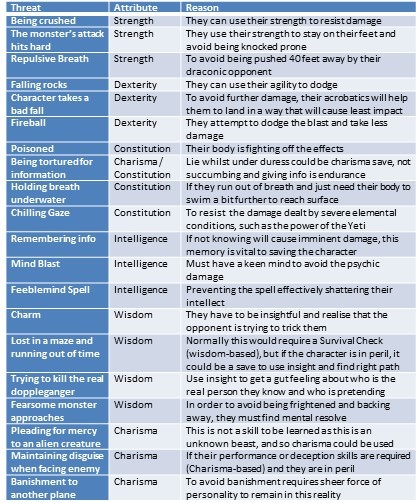
I’ve listed 20 possible scenarios below and sorted them into the attribute the character needs to save against. Next to that is the reason why that attribute is the one being used.
How do you roll a saving throw?
You roll a saving throw against a difficulty class given by the DM. Often these are pre-determined; for example a monster’s attack effects (Beholder’s eye ray effects have a difficulty class is 16) or a magic user’s spells (8 + spell
caster’s ability modifier + proficiency bonus).
For difficulty classes not pre-determined, it is up to the DM to decide how difficult it is to avoid or
resist the threat. These range from very easy (difficulty class of 5) to nearly impossible (dc of 30). The DM should
also say what character attribute it is against.
Now you know what you are rolling against, you roll a d20 die and add you attribute modifier. If your character class has proficiency against that attribute, you add their proficiency number to the die roll. For example, a Level 3 Wizard with intelligence of 16 needs to try and pass an intelligence save. His intelligence modifier is +3 and as a
Level 3 wizard he can add his proficiency of 2. So his saving throw is 1d20 +5.
If the saving throw equals or is greater than the difficulty class, then they successfully save. This normally results in avoiding or reducing the effects that were threatening them.
So does it matter what attribute to use when making a saving throw?
Yes, it will matter to the character making the save. Each class has proficiency in saving throws for two attributes (see list on p.145 of the Player’s Handbook). Here is an example:
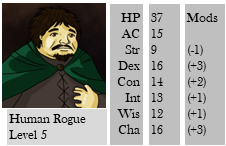
Meet Pevel, a Level 5 rogue from my online RP campaign, Agora Core. Rogues have proficiency in saving throws for Dexterity and Intelligence.
In this example, Pevel is being attacked by a Beholder (yikes!). The Beholder can attack with its many eye rays. Let’s blast Pevel 10 times with 2 different eye rays. The first time through, we will use the Petrification Ray, which requires
a Dexterity saving throw. Then we will repeat the dice rolls but this time, we will use the Sleep Ray, which requires
a Wisdom saving throw. For both, the difficulty class is 16.
Pevel’s rolls without adding modifiers are:
13, 5, 1, 6, 12, 7, 14, 20, 18, 17
Against the Petrification Ray, Pevel uses his Dexterity saving throw. As a Level 5 rogue, he add his proficiency, which is +3. So with his Dexterity modifier, his saving throw is 1d20 + 6.
That means his saving throws rolls are:
19, 11, Nat 1, 12, 18, 13, 20, Nat 20, 24, 23
Against the Sleep Ray, Pevel uses his Wisdom saving throw. As a Level 5 rogue he is not proficient in Wisdom, so simply adds his Wisdom modifier. He saving throw is 1d20 + 1. That means his saving throw rolls were:
14, 6, Nat 1, 7, 13, 8, 15, Nat 20, 19, 18
The difference between the two results shows how your chances of success vary depending on your character’s attributes and class. For the Dexterity saving throw in which Pevel was proficient, he successful rolled 16 or more 6/10 times. But for the Wisdom he only succeeded 3/10 times.
What if there is no threat?
If there is no threat, then the character is not reacting to imminent danger to their life. Any actions they take become an Ability Check instead. These still use the core 6 attributes, but more often than not use skills, which character can have proficiency in. For example, spotting a trap is a Perception Check (Wisdom-based), and working out how to disarm it with an Investigation Check (Intelligence-based).
Many campaigns and one-shots use taverns for their setting, which makes sense as it is often a place for common folk – be they humans or otherwise – to gather and share news over nourishing refreshments. But how do you make your next tavern feel authentic and not another cookie-cutter bar with the same tables, patrons and the mead for sale?
One fun way to keep your players interested is to create varied and mysterious drinks. These can not only provide a local flavor but could also affect the players as well as the weight of the purse.
I designed the following drinks tables for anyone to enjoy so please feel free to use or alter for your own games. The names of the drinks are split into 3 parts with the effects and price from each section described next to it. Like the names, the effects are prices are accumulated together from all 3 sections.
I really enjoyed a recent YouTube video by WebDM that discussed turning D&D clichés into adventuring gold. Most players and Dungeon Masters will recognize the damsel in distress, or the humble beginnings of a party meeting in a tavern. But how should the DM handle the story when using these tricky, well used adventuring paths?
The main takeaway point from the Web DM was to explore the origin of the cliché as it probably became a cliché for good reason. The cited the source material of Conan as being quite different to the lumbering, muscle-head most imagine. In fact, Conan’s savagery is very adaptable and he was a skilled thief among other things.
I always like to think of impersonating someone. If everyone impersonated the impersonator they had just heard, then very soon the resulting voice would be over the top and very one-dimensional; completely separate from the depth and tone of the original.
The other idea Web DM played with was using the player’s assumptions against them. For example, if the players believe the cliché that a damsel is imprisoned by a great beast, then they will not suspect that the ‘damsel’ is in fact sorceress who has captured the dragon.
So let’s look at the clichés that Web DM explored. I’ve compiled them into a table and added my own thoughts as well.
Overall, I’d say try to avoid too many clichés, but when going over familiar ground, look for the originality in it and don’t apologize for it. If players only see a classic storyline, use that to unbalance their perceptions later on!
Although a meal that has been made as instructed in a cook book might be perfectly good, the experience can become dull once we’re used to it. And what if you are catering for a group of friends and you want to surprise them? This is the same problem Dungeons Masters (DMs) encounter when running a Dungeons and Dragons campaign. How do they keep things interesting for players and avoid repetition?
“The dish always tastes better when you do it like this…”
This is thehomebrewoption. If you and your players agree that a certain rule variation makes the game more fun, then you are effectively customising it for your group the same way you might add more salt or take out an ingredient from a recipe. One example might be the old D&D 3.5 rules for a grapple. They were cumbersome and slowed down the gaming. Much easier to agree a workaround with the players to keep the action flowing. Another important area to agree on are the rules for reincarnation when a creature dies. For example, should the players have to do more to prevent the soul of their comrade from leaving the material plane?
“Wow, I didn’t expect that!”
This is the sense of wonderment option. This is when the DM customises a monster or item to surprise the players. In catering terms, you might change the ingredients or appearance of dishes the guests are used to in order to make the meal extra special. See Satine Phoenix’ video exploring this option with Luke Gygax. For the DM, this is especially useful once the players have experience and know what to expect when facing certain creatures or finding magical items. For example, have a cold-weather hybrid of a lizardman, have tactical goblins, a giant, mutated kobold, create a monk character but make their race (or simply appearance) a dryad. As for magical items, the Wand of Wonder is a lot of fun but what about varying it with a bag of means that on a roll might provide you with what you need or could backfire and give you something useless or harmful instead
So happy cooking, whatever you decide to create next! And don’t forget that not every meal or gaming session is perfect, but with work and creativity they’ll continue to be memorable and sometimes they’ll be wonderful.
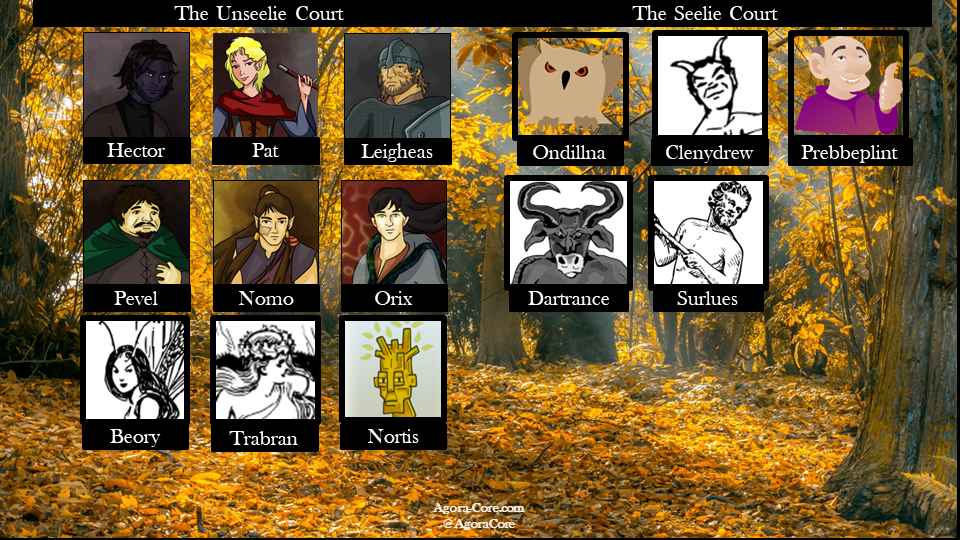
The party are searching for their Drow Warlock Hector, who skipped gleefully away with the fey. Their search takes them to the heart of Queen Lilliope’s court, where the wild things play!